
Your schedule is full, your therapists are busy, and yet cash flow still feels tight. In most practices, the problem isn’t patient volume. It’s the revenue cycle.
RCM in medical billing (revenue cycle management) is the process a healthcare practice uses to track and collect payment for every patient visit, from scheduling and insurance verification through coding, claim submission, denial follow-up and final patient payment. When any step breaks, the practice does the work but doesn’t get paid for it.
In this guide, you’ll learn:
- What RCM means and how it differs from medical billing
- The 12 steps of the RCM process, and the three phases they fall into
- The RCM challenges that cost practices the most money, and how to fix them
- The KPIs every practice owner should check each month
- What changes for physical, occupational and speech therapy practices
- How to decide between in-house and outsourced RCM
What Is RCM in Medical Billing?
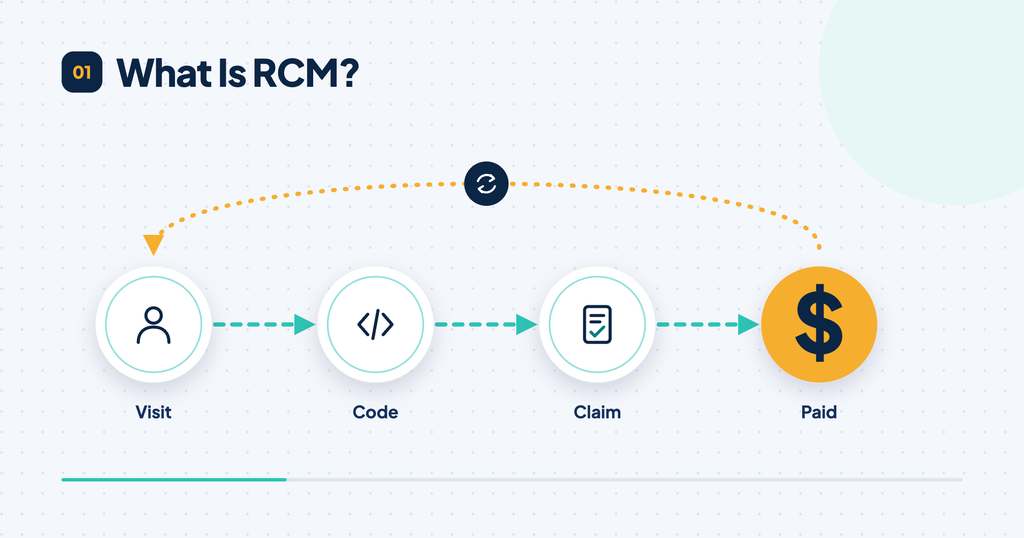
RCM stands for revenue cycle management. In medical billing, it is the full financial process behind every patient encounter: capturing who the patient is and how they’re covered, turning the care you provide into accurate codes and claims, and making sure every dollar owed by payers and patients is actually collected.
The AAPC describes RCM as the process healthcare organizations use to manage the financial side of billing and collecting for medical services. In practice, it touches almost everyone in your clinic: front desk staff, providers, coders, billers and whoever follows up on unpaid accounts.
What does RCM stand for?
RCM stands for revenue cycle management. You may also see it called the “healthcare revenue cycle” or the “medical revenue cycle.” They all mean the same thing.
Why is it called a “cycle”?
It’s called a cycle because it repeats for every visit, and because what happens at the end feeds back into the start. A denial for an expired authorization, for example, should change how your front desk checks authorizations next week. Practices that treat RCM as a loop, not a one-way assembly line, collect more and fix problems faster.
Key takeaway: Medical billing is one step in the revenue cycle. RCM is the entire system that decides whether you get paid, how much and how fast.
Struggling with denials and slow payments? Book a free strategy session and let Perform Practice Solutions handle your billing.
RCM vs. Medical Billing: What does RCM mean in medical terms?
Medical billing creates and sends claims and patient statements. RCM manages everything before, during and after that, so the claim is right the first time and the money actually arrives.
| Medical billing | Revenue cycle management (RCM) | |
|---|---|---|
| Scope | Creating claims and patient bills | The full financial process for every visit |
| Starts | After the visit is documented and coded | When the patient schedules |
| Ends | When the claim or statement is sent | When the balance is paid in full |
| Who’s involved | Billers | Front desk, providers, coders, billers, A/R and leadership |
| Main goal | Accurate, timely claims | Maximum collections, fewer denials, steady cash flow |
| How it’s measured | Claims sent, claim errors | Days in A/R, denial rate, net collection rate |
A practice can have a fast, accurate biller and still lose money. That happens when eligibility isn’t verified, authorizations lapse, or denials sit unworked. That’s an RCM problem, not a billing problem.
The 12 Steps of the Revenue Cycle Management Process
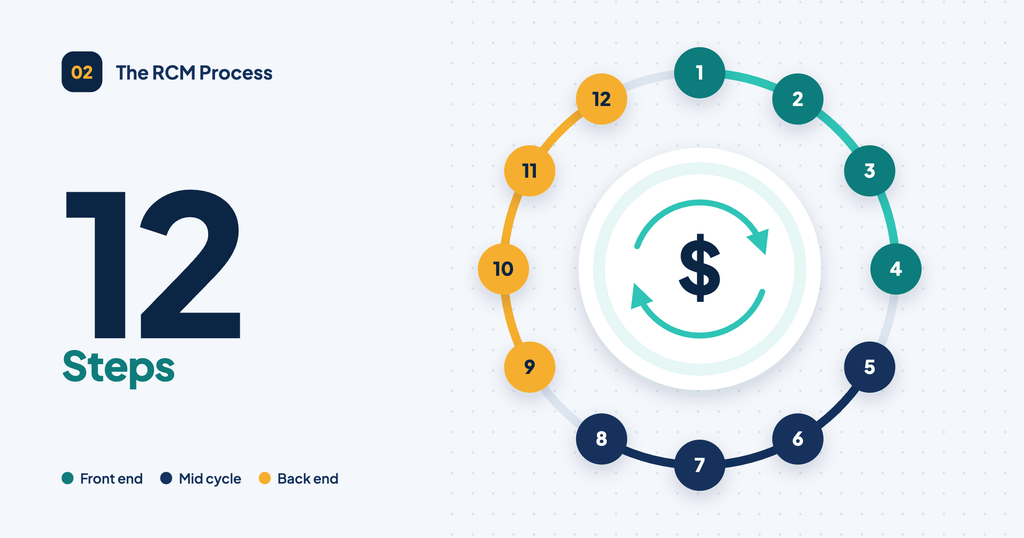
The RCM process has 12 core steps: scheduling and registration, eligibility verification, prior authorization, documentation, coding, charge capture, claim submission, payment posting, denial management, patient billing, A/R follow-up, and reporting. Here’s what happens at each one and where practices most often lose money.
1. Patient scheduling and registration
Collect complete demographics and insurance details, and scan the front and back of the insurance card. A wrong date of birth or member ID is one of the most common causes of denials, and it’s completely preventable.
2. Insurance eligibility and benefits verification
Confirm active coverage, copays, deductibles, coinsurance, visit limits and whether the service is covered. Do it before the first visit and again whenever coverage might change, such as at the start of a new year.
3. Prior authorization
Many payers require approval before certain services, and many therapy plans require it for a set number of visits. Track the authorized visit count and expiration date so care doesn’t continue past what’s approved.
4. Clinical documentation
The provider’s notes must support medical necessity and every billed service. If it isn’t documented, it can’t be billed, and it won’t survive an audit.
5. Medical coding
Coders translate the visit into CPT/HCPCS procedure codes, ICD-10 diagnosis codes and any required modifiers. Coding accuracy drives both payment and compliance.
6. Charge capture
Every service delivered must become a charge in the system. Missed charges are invisible lost revenue, because no one ever sees a denial for a claim that was never created.
7. Claim submission
Claims are scrubbed for errors and sent electronically through a clearinghouse. The goal is a clean claim: one that’s accepted and paid on first submission.
8. Payment posting
Payments from ERAs (electronic remittance advice) and EOBs are posted to patient accounts. Careful posting catches underpayments, where the payer paid less than your contracted rate.
9. Denial management and appeals
Every denial is reviewed, corrected and resubmitted or appealed within the payer’s deadline. Just as important, denials are tracked by root cause so the same mistake doesn’t repeat.
10. Patient billing and collections
Patients receive clear statements for copays, deductibles and coinsurance. Collecting at the time of service is far cheaper and more reliable than mailing statements later.
11. Accounts receivable (A/R) follow-up
Unpaid claims are worked by age and dollar value. Claims with no payer response get followed up before filing deadlines pass.
12. Reporting and analytics
Monthly KPI reports show where the cycle is slowing down and feed fixes back into the front end. This step is what turns a process into a cycle.
The 3 Phases of the Revenue Cycle
The 12 steps group into three phases: the front end (before the visit), the mid-cycle (during and after the visit) and the back end (after the claim is sent).
- Front end: get the patient’s identity, coverage and authorizations right. Most preventable denials start here.
- Mid-cycle: turn care into complete documentation, accurate codes and captured charges.
- Back end: submit, post, follow up and collect, then report what went wrong so the front end can fix it.
Key takeaway: Denials show up on the back end, but most of them start on the front end. That’s why the feedback loop matters.
Why RCM Matters for Healthcare Practices

Strong Revenue Cycle Management is the difference between earning revenue and collecting it. Denials are rising, and payer rules keep changing, so the margin for error keeps shrinking.
The numbers show why:
- 40% of providers say more than 10% of their claims are denied, and 75% say denials are increasing (Experian Health 2026 State of Claims).
- 79% say getting reimbursed has become harder, and 78% say payer policies are changing more often (same survey).
- 86% of denials are potentially avoidable, and registration and eligibility errors are the top cause, at about 27% of denials (Change Healthcare Denials Index, via HFMA).
In other words, most lost revenue isn’t caused by payers. It’s caused by small process gaps that a well-run revenue cycle closes.
What good RCM gives a practice:
- Predictable cash flow. Payments arrive on a steady schedule instead of in feast-or-famine swings.
- Fewer denials and less rework. Clean claims are paid the first time, without costly resubmissions.
- Compliance protection. Accurate coding and documentation reduce audit risk and payer clawbacks.
- A better patient experience. Patients get accurate cost estimates and fewer surprise bills.
- More time for care. Clinicians and staff stop chasing paperwork.
Adding a new provider? Let PPS handle your credentialing so they can start billing sooner.
RCM for Allied Health Practices (PT, OT and Speech Therapy)
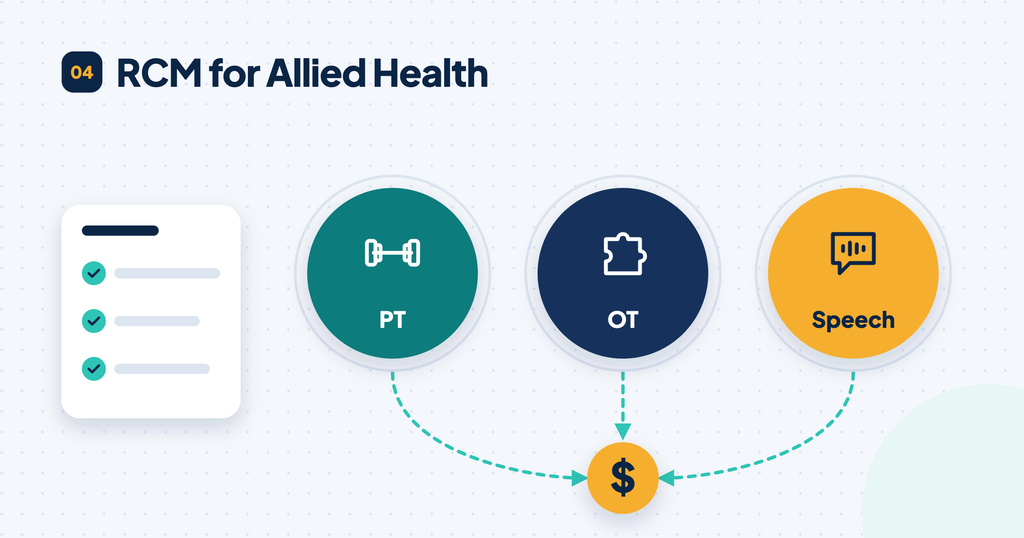
Therapy practices run the same revenue cycle as any other practice, but with more moving parts per patient. One patient may come in for weeks of visits under a single plan of care, so one front-end mistake can repeat on every claim in the episode.
Plans of care and repeat visits
A missed eligibility check on visit one doesn’t cost one claim. It can cost every visit until someone notices. Verify benefits at intake, track visit limits per payer, and re-verify when a plan of care is extended or a new calendar year starts.
Authorizations and visit counts
Many commercial and Medicare Advantage plans authorize a set number of visits within a date range. Build a simple tracker for each patient’s authorized visits, visits used and expiration date. Request re-authorization before the patient runs out, not after.
Timed codes and the 8-minute rule
Most therapy CPT codes are timed, billed in 15-minute units. Under Medicare’s 8-minute rule, billable units depend on the total minutes of timed treatment. Accurate minute tracking in your notes is what protects every unit you bill, in both directions: underbilling leaves money behind, and overbilling creates audit risk.
The Medicare KX modifier threshold
Medicare no longer has a hard therapy cap, but it does have an annual threshold. For 2026, CMS set the KX modifier threshold at $2,480 for PT and speech therapy combined, and $2,480 for OT.
Claims above that amount without the KX modifier are denied. Above $3,000, claims can be selected for targeted medical review (APTA).
Therapy discipline modifiers
Outpatient therapy claims need a discipline modifier: GP for physical therapy, GO for occupational therapy and GN for speech-language pathology. Services delivered in whole or in part by a PTA or OTA may also need the CQ or CO modifier, which Medicare pays at a reduced rate.
Key takeaway: In therapy billing, most denials trace back to tracking: visits, minutes, dollars against the threshold and authorization dates. Fix the tracking and most denials disappear.
Common RCM Challenges (and How to Fix Them)
Most revenue leaks come from the same seven problems. Each has a practical fix.
| Challenge | What it costs you | How to fix it |
|---|---|---|
| Eligibility and registration errors | Denials on otherwise perfect claims | Verify benefits before the first visit; use real-time eligibility checks; re-verify each new year |
| Expired or missing authorizations | Unpaid visits that can’t be appealed | Track authorized visits and end dates for every patient; set re-auth reminders |
| Coding and modifier mistakes | Denials, underpayments, audit risk | Use claim scrubbers, payer-specific rules and regular coder audits |
| Missed timely filing deadlines | Revenue permanently written off | Submit claims within days of the visit; monitor unbilled and no-response claims weekly |
| Unworked denials | Earned money left on the table | Work every denial within a set timeframe; track root causes and fix them upstream |
| Aging A/R | Cash flow gaps, harder collections | Work A/R by age and value; escalate claims older than 60 days |
| Staff turnover | Knowledge gaps, backlogs | Document workflows (SOPs); cross-train; consider outsourcing |
The common thread: denials are cheaper to prevent than to fix. Time spent on front-end accuracy saves far more time in back-end rework.
Key RCM Metrics (KPIs) Every Practice Should Track
You can’t fix what you don’t measure. These six KPIs tell you, in about ten minutes a month, whether your revenue cycle is healthy.
| KPI | What it measures | Common target |
|---|---|---|
| Days in A/R | Average days from visit to payment | Under 40 days; high performers under 30 |
| Clean claim rate | Share of claims accepted on first submission | 95% or higher |
| Initial denial rate | Share of claims denied on first submission | 8% or lower; best-in-class 3% or lower |
| Net collection rate | Share of collectible dollars actually collected, after contractual adjustments | 96% or higher |
| A/R over 90 days | Share of receivables older than 90 days | Under 10% of total A/R |
| Eligibility verified pre-service | Share of visits with coverage confirmed before the appointment | 95% or higher |
Targets are common industry benchmarks, most from MGMA and HFMA, as summarized by ADSC. Your payer mix and specialty will shift what’s realistic, so track the trend month over month, not just one snapshot.
How to read them together: a low clean claim rate usually points to front-end problems such as registration, eligibility or coding. High days in A/R with a good clean claim rate usually means follow-up isn’t happening. A net collection rate below target means money is being written off that shouldn’t be.
Also worth watching: cost to collect, meaning what you spend on billing and collections for every dollar you bring in. It shows whether your RCM is efficient, not just effective.
How Technology and AI Are Changing Revenue Cycle Management
Technology doesn’t replace a good revenue cycle process, but it makes a good process faster and harder to break. In Experian Health’s 2026 State of Claims survey, 84% of providers said AI can improve claims management, and 64% plan to invest in AI for claims and denials.
Where technology helps most today:
- EMR and billing integration. Charges flow from the clinical note to the claim without retyping, so fewer charges get missed.
- Real-time eligibility checks. Coverage and benefits are confirmed in seconds at scheduling, not after a denial.
- Claim scrubbing. Payer-specific edits catch coding and modifier errors before submission.
- Denial analytics. Dashboards group denials by payer and reason so you can fix root causes.
- AI agents and automation. AI can handle repetitive work such as eligibility lookups, claim status checks, patient payment reminders and after-hours phone calls, so staff can focus on exceptions.
The practices getting the most from AI pair it with experienced billers. Automation handles volume; people handle judgment calls, payer escalations and appeals.
In-House vs. Outsourced RCM: Which Is Right for Your Practice?
There’s no single right answer. It depends on your size, payer mix and how much management time you can give billing. Here’s how the two models compare.
| Factor | In-house RCM | Outsourced RCM |
|---|---|---|
| Cost structure | Salaries, benefits, software, training | Usually a percentage of collections or a flat fee |
| Expertise | Limited to your team’s experience | A team that works across many payers and specialties |
| Coverage | At risk when staff are sick, on leave or quit | Built-in backup and continuity |
| Technology | You buy and maintain it | Usually included |
| Control and visibility | Direct, day-to-day | Through regular reports and a dedicated contact |
| Scaling | Hire and train as you grow | Scales with your volume |
Signs it’s time to outsource
- Days in A/R keep creeping above 40
- Denials are piling up faster than your team can work them
- One person holds all the billing knowledge
- You’re opening a new location or adding providers
- You, the owner, are spending evenings on billing instead of patients or growth
5 questions to ask an RCM partner
- Do you specialize in our specialty and our main payers?
- Which KPIs do you report, and how often?
- Who is our day-to-day contact?
- How do you handle denials and appeals, and how fast?
- What does onboarding look like, and how do you protect cash flow during the switch?
How Perform Practice Solutions Helps Practices Get Paid Faster
Perform Practice Solutions runs the revenue cycle for more than 30 active clinic clients, with deep experience in allied health billing. We handle the full cycle, from eligibility and authorizations to coding review, claim submission, denial management and A/R follow-up, so your team can focus on patients.
What practices get with PPS:
- End-to-end medical billing and RCM, run by billers who know therapy payers and rules
- Credentialing, so new providers can bill sooner
- Clear monthly reporting on the KPIs in this guide
- Front office and virtual staffing support for intake, verification and patient calls
- Custom AI agents and automation that cut repetitive work across the cycle
- Practice consulting and coaching led by CEO Kevin Rausch
FREQUENTLY ASKED QUESTIONS
RCM stands for revenue cycle management. It’s the process healthcare practices use to track and collect payment for patient services, from scheduling and insurance verification through coding, claims, denials and final patient payment.
Medical billing is one step inside RCM: creating and sending claims and patient bills. RCM covers the entire financial process, including registration, eligibility checks, authorizations, coding, payment posting, denial management and A/R follow-up.
The main RCM steps are patient registration, eligibility verification, prior authorization, clinical documentation, coding, charge capture, claim submission, payment posting, denial management, patient billing, A/R follow-up, and reporting.
Everyone touches RCM. Front desk staff own registration and eligibility, providers own documentation, coders and billers own claims, and leadership owns the KPIs. Many practices outsource most of the cycle to a billing company.
Revenue cycle management (RCM) is the process healthcare practices use to track and collect payment for patient care. It starts when a patient schedules an appointment and ends when the balance is paid in full. It covers registration, insurance verification, coding, claim submission, payment posting, denial management and patient collections.
There’s no single official list, but the 7 most commonly cited steps are: Patient registration, Insurance eligibility verification, Charge capture, Medical coding, Claim submission, Payment posting, Denial management and A/R follow-up.