
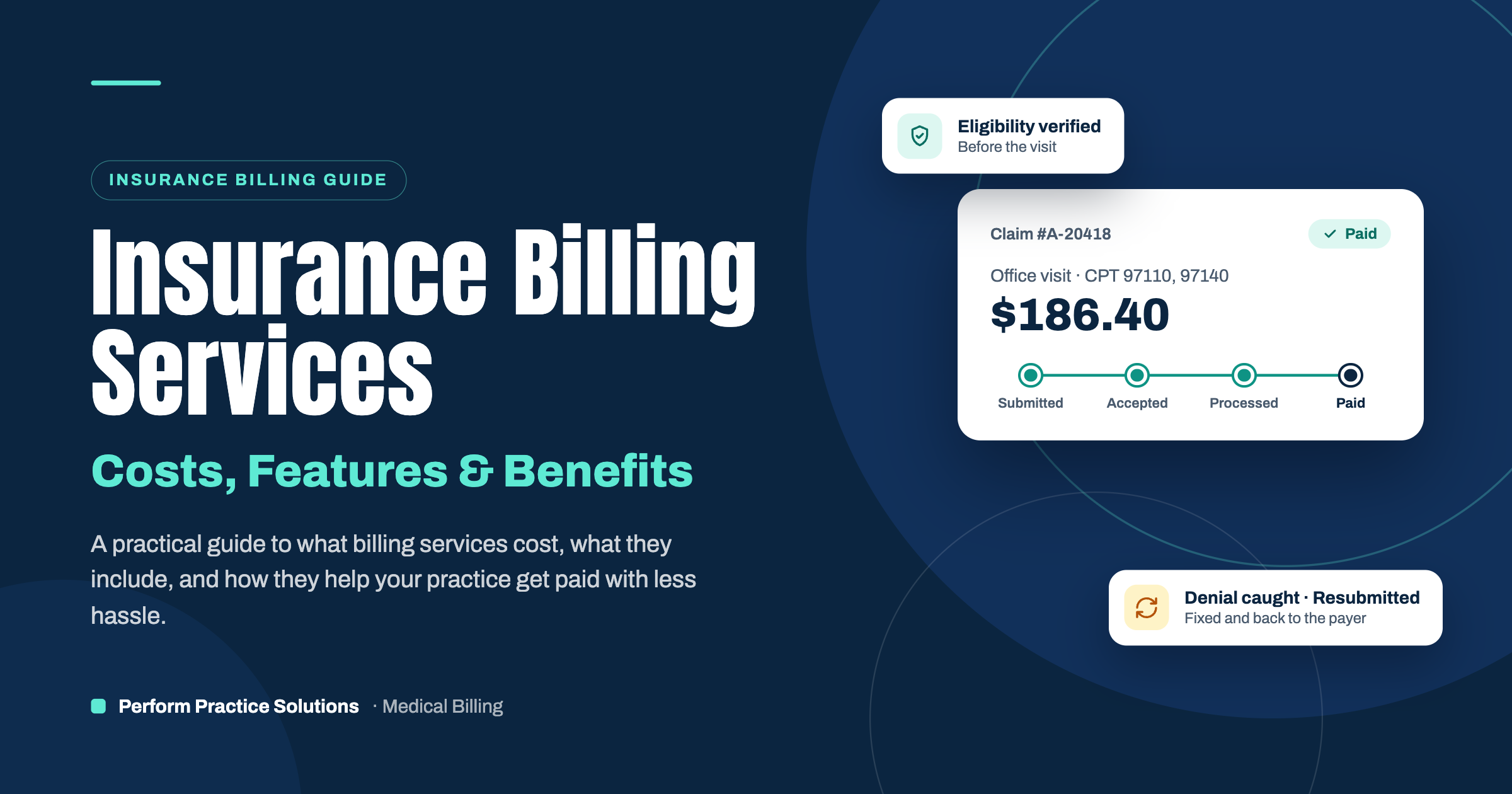
Insurance billing services are third-party companies or in-house systems that handle the full process of submitting claims to payers, following up on denials, and collecting reimbursements on behalf of healthcare providers.
For most Allied Health practices, outsourcing this function reduces administrative burden, shortens payment cycles, and increases the percentage of claims that get paid on the first submission.
Perform Practice Solutions specializes in insurance billing services designed specifically for Allied Health providers, including physical therapy, occupational therapy, speech therapy, chiropractic, behavioral health, and other specialty practices.
Why Your Revenue Cycle Depends on Getting Billing Right
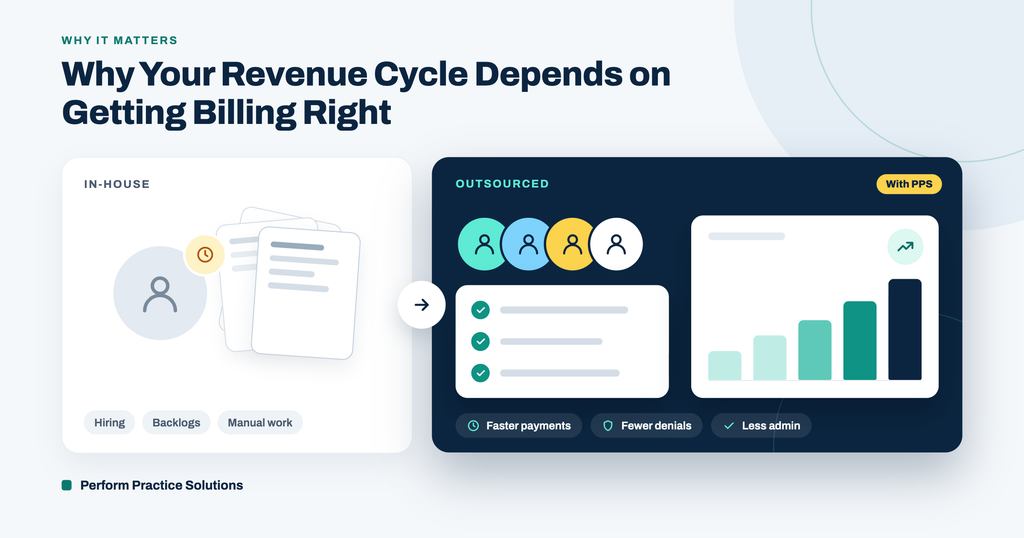
Most clinicians spend years training to treat patients and almost no time learning payer rules, modifier requirements, or claim scrubbing logic. The result is predictable: claims go out with errors, denials pile up, and revenue that should have arrived in three weeks sits unresolved for two months.
The American Medical Association estimates that claim errors and administrative inefficiencies cost the U.S. healthcare system over $350 billion annually. For individual practices, even a 5% denial rate can translate into tens of thousands of dollars left on the table each year.
Here is what typically breaks down inside a practice billing workflow:
- Claims submitted in weekly batches instead of daily, which delays cash flow from the start
- Missing or outdated payer credentialing that causes automatic rejections
- No systematic follow-up on denials past 30 days
- Patient balance collections handled inconsistently or not at all
- No monthly performance review to catch patterns before they compound
When any one of these fails consistently, the entire revenue cycle suffers. A well-structured billing operation addresses all of them simultaneously, not just the submission step.
How Insurance Billing Services Actually Work
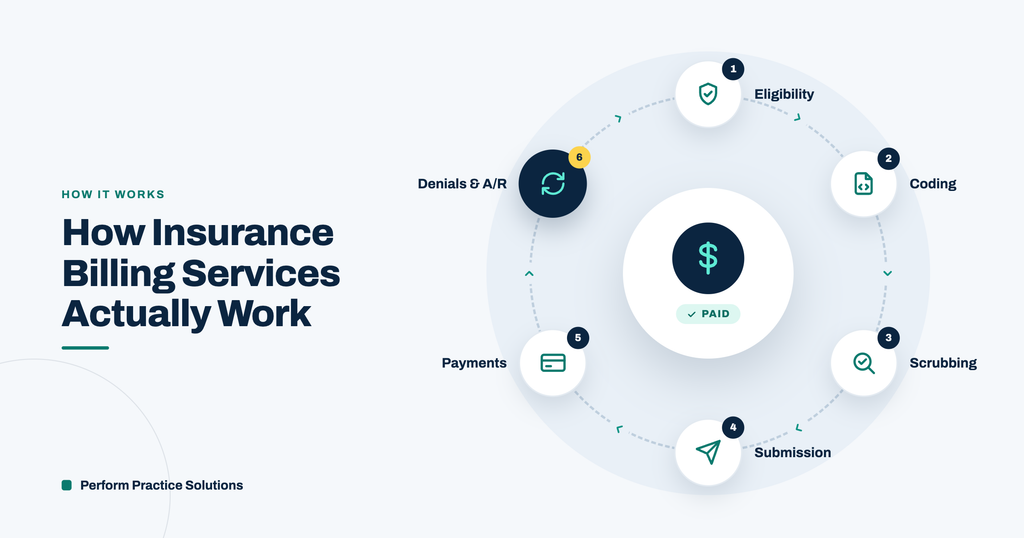
The Insurance Claims Billing Services Claim Lifecycle From Start to Finish
1. Patient registration and eligibility verification
The billing process is more layered than most practice owners realize. It starts well before a claim is filed and extends well after a check is deposited.
Before a patient is ever seen, their insurance coverage needs to be confirmed. Benefits verification catches coverage gaps, deductible status, and authorization requirements upfront rather than after services are rendered.
2. Charge capture and coding
Every service delivered must be translated into the correct CPT codes, diagnosis codes (ICD-10), and modifiers. Errors here are the single largest driver of claim denials.
3. Claim scrubbing
Before submission, claims are checked against current payer rules. This is where a quality billing team earns its fee. Catching errors pre-submission eliminates the 2-3 week denial and resubmission loop.
4. Electronic submission
Claims are transmitted via an electronic data interchange (EDI) system directly to payers. High-volume billing services submit daily, which is a key distinction from practices that batch submissions weekly or biweekly.
5. Payment posting and reconciliation
When payers respond, payments need to be posted accurately against each claim. This is where understanding EOB and 835 transaction files becomes critical (covered in the FAQ below).
6. Denial management and appeals
Any denied or underpaid claim should trigger an immediate review. The best services track denial reasons by payer, identify patterns, and adjust submission behavior accordingly.
7. Patient balance follow-up
After insurance pays its portion, remaining patient balances need to be billed, tracked, and collected. Many practices lose significant revenue here simply because no one follows up.
Types of Medical Billing Services and How They Compare
Not all billing services are built the same. The right fit depends on your practice size, specialty, and how much visibility you want into the process.
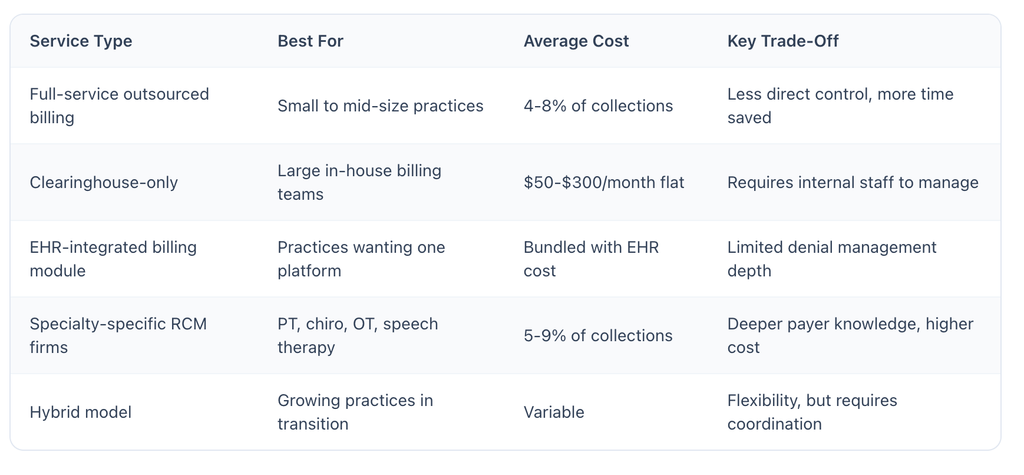
For Allied Health practices specifically, physical therapy, chiropractic, occupational therapy, and speech therapy clinics benefit most from specialty-specific services. Payer rules for these disciplines differ substantially from general medical billing, and a generalist firm often misses modifier requirements or authorization nuances that cost money.
Perform Practice Solutions focuses exclusively on these specialties, which is one reason their clients report a 16% average revenue increase after onboarding. The depth of payer knowledge in a specialty context is not easily replicated by a generalist billing firm.
What to Look for a Premium Insurance Billing Services Partner
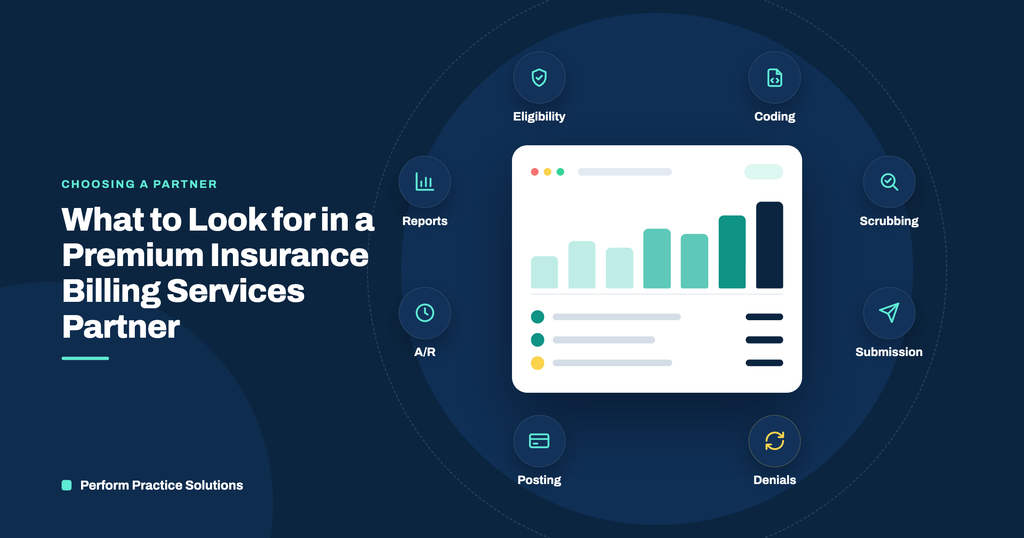
Choosing the right billing service requires asking specific questions, not just comparing price percentages. Here is what actually separates high-performing billing partners from mediocre ones.
Performance Benchmarks That Matter
- Clean claim rate: Industry standard is around 95%. A strong partner hits 97-98%. Perform Practice Solutions reports a 98% average clean claim rate across client accounts.
- Days in accounts receivable: Target under 30 days. Industry average runs 45-60 days. The right billing operation can bring this down to around 3 weeks.
- Denial rate: Under 5% is acceptable. Under 2% is excellent.
- First-pass resolution rate: What percentage of claims are paid without any follow-up required? Higher is better.
Important Questions to Ask Before Signing a Medical Insurance Billing Services
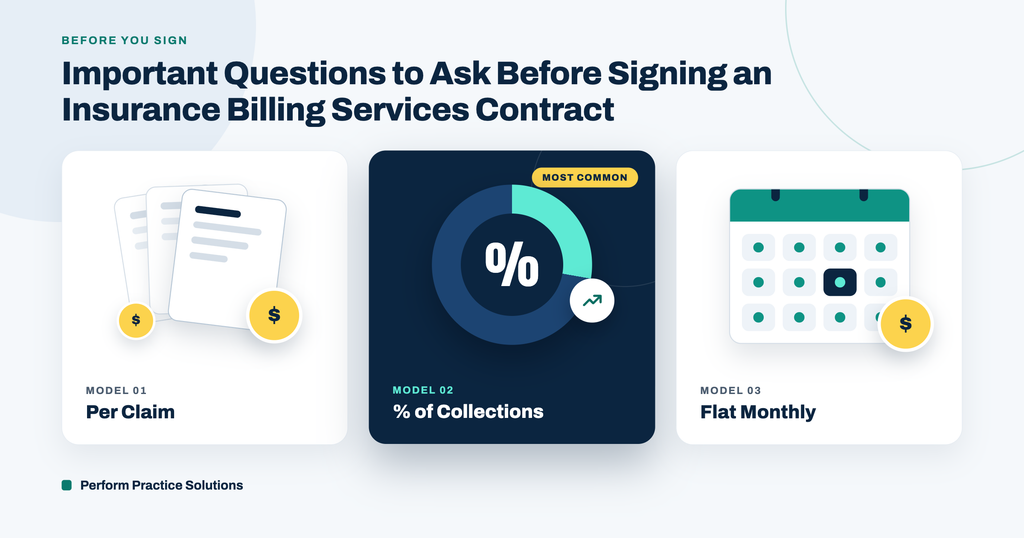
Before choosing an insurance billing service, it is important to understand how the provider manages claims, handles payment delays, and supports your practice’s overall revenue cycle. Asking the right questions upfront can help you identify potential gaps, avoid unexpected costs, and determine whether the service aligns with your practice’s needs.
- Do you bill daily or in weekly batches? Frequent claim submissions can help reduce reimbursement delays and maintain a more consistent cash flow. Ask about the provider’s submission schedule, how quickly claims are processed after a patient visit, and whether there are established procedures for preventing backlogs.
- Who manages denial management, and what is your appeal success rate? Denied claims can significantly affect your revenue if they are not addressed promptly. Find out whether the billing team actively investigates denial reasons, corrects claim errors, submits appeals, and follows up with insurance payers. Ask for performance metrics, such as denial rates and appeal success rates, to evaluate how effectively the provider recovers revenue.
- Do you handle patient balance collections or only insurance claims? Some billing services focus exclusively on insurance reimbursements, leaving your staff responsible for collecting copayments, deductibles, coinsurance, and outstanding patient balances. Understanding the scope of the service helps you determine whether you need additional administrative support or a more comprehensive revenue cycle management solution.
- What reporting does your platform provide, and how often? Regular reporting gives you visibility into your practice’s financial performance. Ask whether the provider offers reports on accounts receivable (AR), claim denials, reimbursement timelines, collection rates, and outstanding balances. You should also clarify how frequently reports are delivered and whether you will have access to a dashboard for monitoring performance in real time.
- Do you offer credentialing support alongside billing? Insurance credentialing and payer enrollment are essential to maintaining your ability to bill insurance companies and receive reimbursements. Ask whether the provider manages initial credentialing, recredentialing, payer enrollment applications, and updates to provider information. Combining credentialing support with billing can help prevent administrative oversights that disrupt payments.
That last question matters more than most practices realize.
A lapse in credentialing or an issue with payer enrollment can delay or disrupt reimbursements, particularly when a provider’s participation status with a major insurance company is affected. For practices that rely on payers such as Blue Cross Blue Shield (BCBS), Aetna, Cigna, or UnitedHealthcare, keeping enrollment records current and monitoring credentialing deadlines is essential.
A billing partner that also manages credentialing can help close one of the most common gaps in the revenue cycle. By coordinating payer enrollment, maintaining provider records, and monitoring renewal requirements alongside routine claim processing, the right partner can help reduce administrative burdens and minimize preventable reimbursement disruptions.
If you are looking for
Things to Know
- Many billing services charge a percentage of collections, not a flat fee. This means their incentive is aligned with yours, but your cost scales as revenue grows.
- Credentialing and billing are separate services. Some providers bundle them, some do not. If your practice has new providers joining or payer contracts expiring, ask specifically what is covered.
- HIPAA compliance is non-negotiable. Any billing partner handling protected health information (PHI) must sign a Business Associate Agreement (BAA) with your practice.
- Smaller practices often assume outsourcing is only for large hospital systems. In reality, a solo or two-provider clinic typically benefits more because the time savings relative to staff cost is significantly higher.
- If your practice uses an EHR with a built-in billing module, that does not automatically mean you have denial management or follow-up coverage. Those functions often require separate configuration or staffing.
- Monthly reporting is the minimum standard. A quarterly review with a senior team member, like a COO-level analysis, provides a deeper look at payer trends, collection patterns, and areas for adjustment.
Conclusion
Getting billing right is not a back-office detail. It is the financial infrastructure that determines whether your practice grows, stalls, or quietly bleeds revenue through errors and delays. The right billing partner compresses your payment cycle, raises your clean claim rate, and handles the follow-up work that most practices simply do not have the bandwidth to do consistently.
Perform Practice Solutions delivers exactly this kind of infrastructure for Allied Health practices across the country. Whether you are running a physical therapy clinic, a chiropractic practice, or a speech therapy office, the combination of daily billing, AI-powered claim tracking, credentialing management, and hands-on reporting puts your revenue cycle on a fundamentally different trajectory.
Visit performpracticesolutions.com and book your Strategy Session to see what that looks like for your specific practice.
Frequently Asked Questions
- What is an insurance billing services for small practices?
Small practices benefit significantly from outsourcing because the cost of hiring, training, and retaining an in-house billing specialist often exceeds the percentage fee charged by a professional billing service.
For a solo provider or a clinic with two to four practitioners, the math tends to favor outsourcing quickly. A billing service charges roughly 4-8% of collections, while a full-time in-house biller in the U.S. costs between $45,000 and $60,000 annually in salary alone, before benefits and training.
- What is an Insurance billing service in the USA?
In the United States, insurance billing services operate within a tightly regulated environment governed by HIPAA, CMS billing rules, and payer-specific contracts that vary by state and network.
- What is a billing service?
A billing service is a company or platform that manages the process of submitting claims to insurance payers, following up on denials, posting payments, and collecting balances on behalf of a healthcare provider.
- What are the different types of medical billing services?
The main types include full-service outsourced billing, clearinghouse-only platforms, EHR-integrated billing modules, specialty-specific revenue cycle management (RCM) firms, and hybrid models that combine outsourced and in-house functions.
Full-service outsourced billing is the most comprehensive option and is typically the best fit for practices that want to remove billing from their internal workload entirely. Specialty-specific RCM firms offer deeper payer expertise for disciplines like physical therapy or chiropractic. Clearinghouse platforms are best suited for larger practices with strong internal billing teams that just need an electronic submission infrastructure.
- What is the difference between EOB and 835?
An Explanation of Benefits (EOB) is a paper or PDF document sent to providers and patients explaining how a claim was processed, while an 835 is a standardized electronic transaction file that delivers the same payment information in a machine-readable format directly into billing software.