
You hired a great new provider. Their schedule is full. But for the first two, three, maybe four months, your practice may not be able to bill a single insurance claim for their visits.
That gap is the credentialing problem, and it catches practices of every size off guard. Healthcare credentialing services close that gap: they verify a provider’s qualifications, enroll them with insurance payers, and keep their credentials current so claims get paid.
This guide covers how the credentialing process works step by step, how long it really takes, what it costs, and how to decide whether to handle it in-house or hand it to a partner.
Key takeaways
- Credentialing verifies a provider’s qualifications. Payer enrollment is what actually lets you bill. You need both.
- Most commercial payers take 90 to 120 days; Medicare often takes 60 to 90 days.
- Incomplete applications and outdated CAQH profiles cause most delays.
- Credentialing never really ends: CAQH re-attestation, Medicare revalidation and payer re-credentialing all recur.
- Outsourcing makes sense when you’re adding providers, opening a practice, or watching claims deny for enrollment issues.
What Are Healthcare Credentialing Services?
Healthcare credentialing services verify that a provider is qualified to practice and enroll that provider with insurance payers so the practice can be reimbursed for their care. A credentialing service collects the provider’s documents, submits applications, follows up with payers and tracks every expiration date so nothing lapses.
What medical credentialing means
Medical credentialing is the formal review of a provider’s education, training, licensure, work history and professional standing. Payers and facilities confirm each item directly with the issuing source, such as a medical school, state licensing board or certification body. This is called primary source verification.
What a credentialing service handles
A full-service credentialing partner typically takes on:
- Building and maintaining the provider’s CAQH ProView profile
- NPI registration and updates through NPPES
- Medicare enrollment through PECOS and state Medicaid enrollment
- Commercial payer applications and contract requests
- Follow-up calls and status tracking with each payer
- Confirming effective dates and loading providers into your billing system
- Re-credentialing, revalidation and license or certificate expiration tracking
Who needs credentialing
Any provider who bills insurance needs it. That includes physicians, nurse practitioners, physician assistants, physical therapists, occupational therapists, speech-language pathologists, chiropractors and behavioral health clinicians. It also applies to new practices, practices adding a provider, providers changing locations or tax IDs, and practices adding new payers.
The differences of Healthcare Credentialing vs. Payer Enrollment vs. Privileging
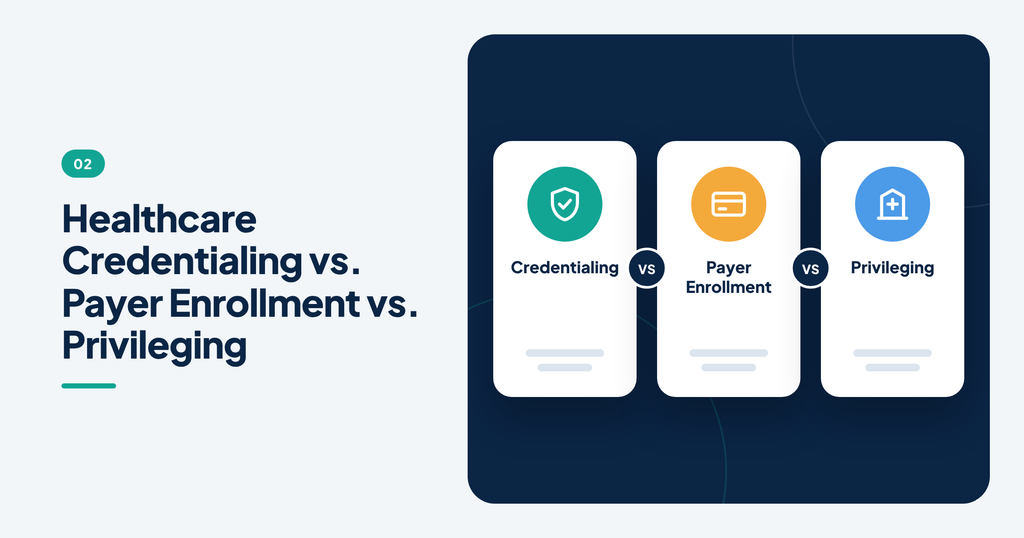
Credentialing, payer enrollment and privileging are three separate processes, and a provider can finish one while still being blocked by another. Most practices say “credentialing” to mean all three, which is exactly why delays are hard to diagnose.
| Credentialing | Payer enrollment | Privileging | |
|---|---|---|---|
| What it does | Verifies the provider’s qualifications | Adds the provider to a payer’s network and contract | Grants permission to perform specific procedures at a facility |
| Who grants it | Payers, hospitals, health systems | Insurance companies, Medicare, Medicaid | Hospitals, surgery centers |
| What it unlocks | Eligibility to join a network | The ability to bill and be paid in-network | The right to treat patients at that facility |
| Typical trigger | New provider, new payer, re-credentialing cycle | After credentialing is approved | Hospital or ASC affiliation |
The distinction that matters most for revenue: a provider who is credentialed but not yet enrolled and loaded into the payer’s system still cannot bill. Claims submitted in that window deny as out-of-network. Even a signed contract isn’t the finish line; the payer still has to load the provider before claims process correctly.
Why a Healthcare Credentialing Matters for Your Practice’s Revenue
Credentialing decides when a provider starts generating revenue. Every day a provider sees patients without an active enrollment is a day of care you may never be paid for.
1. You can’t bill until enrollment is effective
Payers only pay claims for dates of service on or after the provider’s effective date. Commercial payers rarely backdate that date. Medicare allows limited retroactive billing, generally up to 30 days before the filing date under 42 CFR 424.521, but anything earlier is lost.
2. Delays add up fast
Here’s a simple way to size the risk for your own practice:
Revenue at risk = average daily collections per provider × days without an active enrollment
For example, a provider who would collect $1,500 a day loses roughly $45,000 for each month enrollment is delayed. Most practices also absorb rework costs: resubmitted claims, write-offs and staff hours spent chasing payers.
3. Compliance and Medicare billing privileges
Medicare requires providers to revalidate their enrollment on a set cycle, generally every five years. Miss the deadline and CMS can deactivate billing privileges, which stops payment until enrollment is reinstated. Missed CAQH re-attestations and expired licenses cause similar interruptions with commercial payers.
4. Patient access and trust
Patients choose providers who are in their network. If your new provider isn’t in-network yet, you either turn patients away, reschedule them, or treat them knowing the claim may deny. None of those outcomes build loyalty.
Read related article: Insurance Billing Services: A Complete Guide to Costs, Features & Practice Fit
The Step by Step Healthcare Credentialing Process
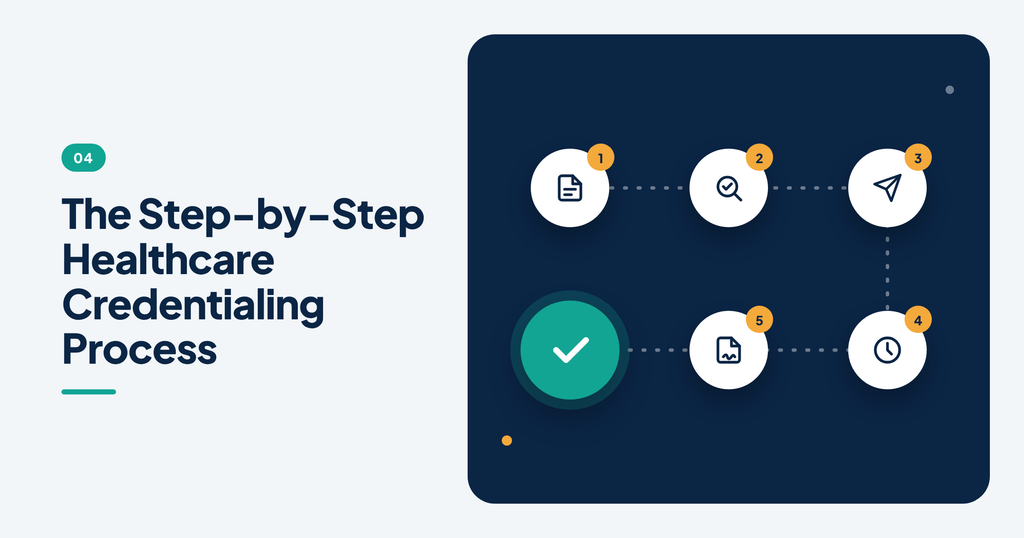
The credentialing process moves through eight stages, from collecting documents to ongoing maintenance. Skipping or rushing any one of them is the most common reason applications stall.
- Collect provider documents and data. Gather licenses, certifications, education and training records, work history, malpractice coverage and identification. Check every name, address and date for consistency before anything is submitted.
- Set up NPI and CAQH ProView. Confirm the provider’s individual NPI (Type 1) and, for group billing, the organization’s NPI (Type 2). Build or update the CAQH ProView profile, upload documents, and authorize each payer to view it.
- Primary source verification. Payers and credentialing verification organizations confirm licenses, board certifications, education and sanctions directly with the issuing sources.
- Submit payer applications. File Medicare enrollment through PECOS (CMS-855I for individuals, CMS-855B for groups, and CMS-855R to reassign benefits to the practice), state Medicaid enrollment, and each commercial payer’s application.
- Follow up and track status. Payers rarely call you with problems. Check each application on a set schedule, every one to two weeks, and respond to requests for information the same day.
- Contracting and loading. Once credentialing is approved, review and sign the payer contract, then confirm the payer has loaded the provider into its claims system.
- Confirm the effective date and start billing. Get the effective date in writing for each payer and location. Hold or route claims until it’s confirmed.
- Maintain and re-credential. Re-attest CAQH, renew licenses and certifications, and respond to payer re-credentialing and Medicare revalidation requests before deadlines.
Pro tip: Run credentialing and enrollment steps in parallel wherever payers allow. Starting payer applications while the CAQH profile and verifications are still in progress can shave weeks off the timeline.
The Documents You’ll Need for a Provider Credentialing Checklist
Having these documents ready before you start is the single best way to avoid delays. Requirements vary by payer, state and specialty, so treat this as a starting list.
Identity and practice information
- Government-issued photo ID
- Individual NPI and group NPI
- Practice tax ID (EIN) and IRS confirmation letter (CP-575 or 147C)
- Signed W-9
- Practice locations, phone numbers and hours
Licensure and certification
- Current state professional license(s) for every state of practice
- DEA registration and state controlled-substance registration (if applicable)
- Board or specialty certifications
- CPR/BLS or other required certifications
Education and work history
- Degree(s) and diplomas
- Residency, fellowship or clinical training certificates
- Current CV with month/year dates and explanations for any gap over six months
- Hospital affiliations or admitting arrangements (if applicable)
Insurance and attestations
- Current malpractice insurance certificate (face sheet)
- Malpractice claims history
- Signed attestation and release forms
- Active CAQH ProView login and recent attestation
How Long Does Healthcare Credentialing Take?
Healthcare credentialing typically takes 60 to 180 days per payer, with most commercial payers landing between 90 and 120 days from a complete application. The payer controls the clock, but the quality of your application decides whether you hit the short or long end.
Typical timelines by payer type
| Payer type | Typical timeline | What affects it |
|---|---|---|
| Medicare (PECOS) | 60 to 90 days | Accuracy of 855 forms, MAC backlog, revalidation status |
| Commercial payers | 90 to 120 days | CAQH completeness, panel availability, committee schedules |
| Medicaid | Varies widely by state | State-specific forms, site visits, MCO enrollment on top of state enrollment |
| Contracting and loading (after approval) | Often another 30 to 45 days | Contract negotiation, payer system loading |
Advanced practice providers such as NPs and PAs can take longer with some payers. In some cases the process has stretched close to a year, and the provider is treated as out-of-network the entire time.
Read related article: The Complete Guide to Medical Billing Audits
The most common causes of credentialing delays
- Incomplete or inconsistent applications: a name, address or date that doesn’t match across documents
- CAQH problems: an expired attestation, missing documents, or payers not authorized to view the profile
- NPI errors: using the individual NPI where the group NPI is required, or outdated NPPES data
- Closed panels: the payer isn’t accepting new providers in your area or specialty
- No follow-up: applications sit in a queue because no one is checking status
How to speed up credentialing
- Start at least 120 days before the provider’s first day, earlier for Medicaid and hospital-based payers.
- Get the CAQH profile fully complete and attested before submitting any payer application.
- Run credentialing and enrollment steps in parallel where payers allow.
- Ask each payer whether a retroactive effective date is available, and request it in writing.
- Track every application on one shared tracker with a follow-up date.
How Much Do Healthcare Credentialing Services Cost?
The true cost of credentialing is the service fee plus every day a provider can’t bill plus the cost of fixing mistakes. A low fee that comes with slow follow-up is usually the most expensive option.
Total credentialing cost = service fee + unbillable days + rework
Common pricing models
| Model | How it works | Best for |
|---|---|---|
| Per provider, per payer | A flat fee for each application submitted | Practices adding one or two providers |
| Per provider package | One fee covers a set number of payers | New practices building a payer mix |
| Monthly maintenance | Ongoing fee for CAQH upkeep, re-credentialing and tracking | Established practices with several providers |
| Bundled with billing | Credentialing included in a billing or RCM agreement | Practices that want one partner for the full revenue cycle |
The hidden cost of doing it yourself
In-house credentialing isn’t free. It costs staff hours, often from an office manager who is also running the front desk. It also costs revenue when applications stall. Before comparing quotes, estimate how many days of collections your last few delays cost you.
In-House vs. Outsourced Healthcare Credentialing: Which Is Right for You?
Keep credentialing in-house if you have a stable provider roster and a dedicated, experienced coordinator. Outsource it if you’re growing, short on staff, or already losing revenue to enrollment problems.
| In-house credentialing | Outsourced credentialing services | |
|---|---|---|
| Control | Full visibility and direct payer contact | Shared visibility through reports or a portal |
| Expertise | Depends on one or two staff members | A team that works payer rules every day |
| Capacity | Strained when several providers start at once | Scales with your hiring |
| Continuity | At risk if your coordinator leaves | Process and records stay with the partner |
| Cost | Salary, training, software, staff time | Service fee, usually per provider or monthly |
| Follow-up | Often slips behind daily operations | Scheduled and tracked |
Signs it’s time to outsource
- You’re opening a new practice or adding a location.
- You’re hiring more than one provider in the next six months.
- Claims are denying for enrollment or out-of-network reasons.
- Your office manager handles credentialing “when there’s time.”
- You’ve missed a CAQH attestation, license renewal or revalidation deadline.
How to Choose the Right Healthcare Credentialing Service
The right credentialing partner knows your specialty’s payers, reports status without being asked, and connects credentialing to billing so nothing falls between the cracks.
1. Experience in your specialty
Payer requirements differ for physical therapy, behavioral health, primary care and surgical specialties. Ask how many practices like yours the service credentials today and which payers in your state they work with most.
2. Clear turnaround times and reporting
No service controls payer timelines, but a good one tells you where every application stands. Look for scheduled status reports, a named point of contact, and a clear escalation process when a payer stalls.
3. Full scope of service
Confirm the service covers CAQH setup and re-attestation, Medicare and Medicaid enrollment, commercial applications, contracting support, and ongoing re-credentialing. A partner that stops at “application submitted” leaves the hardest part to you.
4. Connection to billing
Credentialing problems show up as billing problems: denials, holds and write-offs. A partner that also handles your billing can spot an enrollment issue the first time a claim denies, rather than weeks later.
5. Questions to ask before you sign
- Which payers and states do you credential with most often?
- Who will be my day-to-day contact?
- How often will I get status updates, and in what format?
- Do you request retroactive effective dates when payers allow them?
- Do you handle re-credentialing, CAQH re-attestation and Medicare revalidation?
- Who owns the provider files and data if we part ways?
- How do you coordinate with our billing team or EMR?
Staying Credentialed: Re-Credentialing, Re-Attestation and Revalidation
Getting credentialed is a milestone, not a finish line. Three recurring deadlines keep a provider in-network, and missing any of them can stop payments.
| Requirement | How often | What happens if it’s missed |
|---|---|---|
| CAQH ProView re-attestation | Every 120 days | Payers can’t view a current profile, which stalls applications and re-credentialing |
| Payer re-credentialing | Commonly every 3 years | The provider can be termed from the network |
| Medicare revalidation | Generally every 5 years | Billing privileges can be deactivated |
| License, DEA and certification renewals | Varies by state and credential | Expired credentials can trigger network termination |
The fix is a single calendar of every expiration date for every provider, with reminders set 90 days out. Credentialing services typically manage this for you.
Ready to get your providers in-network faster? Book a free credentialing consultation with Perform Practice Solutions.
Frequently Asked Questions
A credentialing service is a company that manages provider credentialing and insurance enrollment for medical practices. Healthcare credentialing services collect provider documents, maintain CAQH profiles, submit applications to Medicare, Medicaid and commercial payers, follow up until approval, and track renewal dates so providers stay in-network and claims get paid.
The two main types of credentialing are insurance (payer) credentialing and hospital (facility) credentialing. Insurance credentialing lets a provider join a payer’s network and bill for services. Hospital credentialing, usually paired with privileging, lets a provider treat patients at a specific facility. The two run separately, so finishing one doesn’t complete the other.
Credentialing in US healthcare is the process of verifying a provider’s education, training, licensure, work history and professional standing before they can join an insurance network or practice at a facility. Payers and hospitals confirm each item with the original source to protect patients and meet federal, state and accreditation requirements.
Provider credentialing works in stages: collect the provider’s documents, set up their NPI and CAQH ProView profile, submit applications to each payer, complete primary source verification, then sign the contract and confirm the effective date. After approval, the provider is re-credentialed on a recurring cycle. Healthcare credentialing services manage each stage and the follow-up.
Provider credentialing usually takes 60 to 180 days per payer. Medicare often takes 60 to 90 days, and most commercial payers take 90 to 120 days from a complete application. Contracting and loading the provider into the payer’s system can add more time after approval.
Credentialing verifies that a provider is qualified. Payer enrollment adds that provider to an insurer’s network and activates them for billing. A provider can be credentialed but still unable to bill until enrollment, contracting and loading are complete, which is why healthcare credentialing services handle both together.