
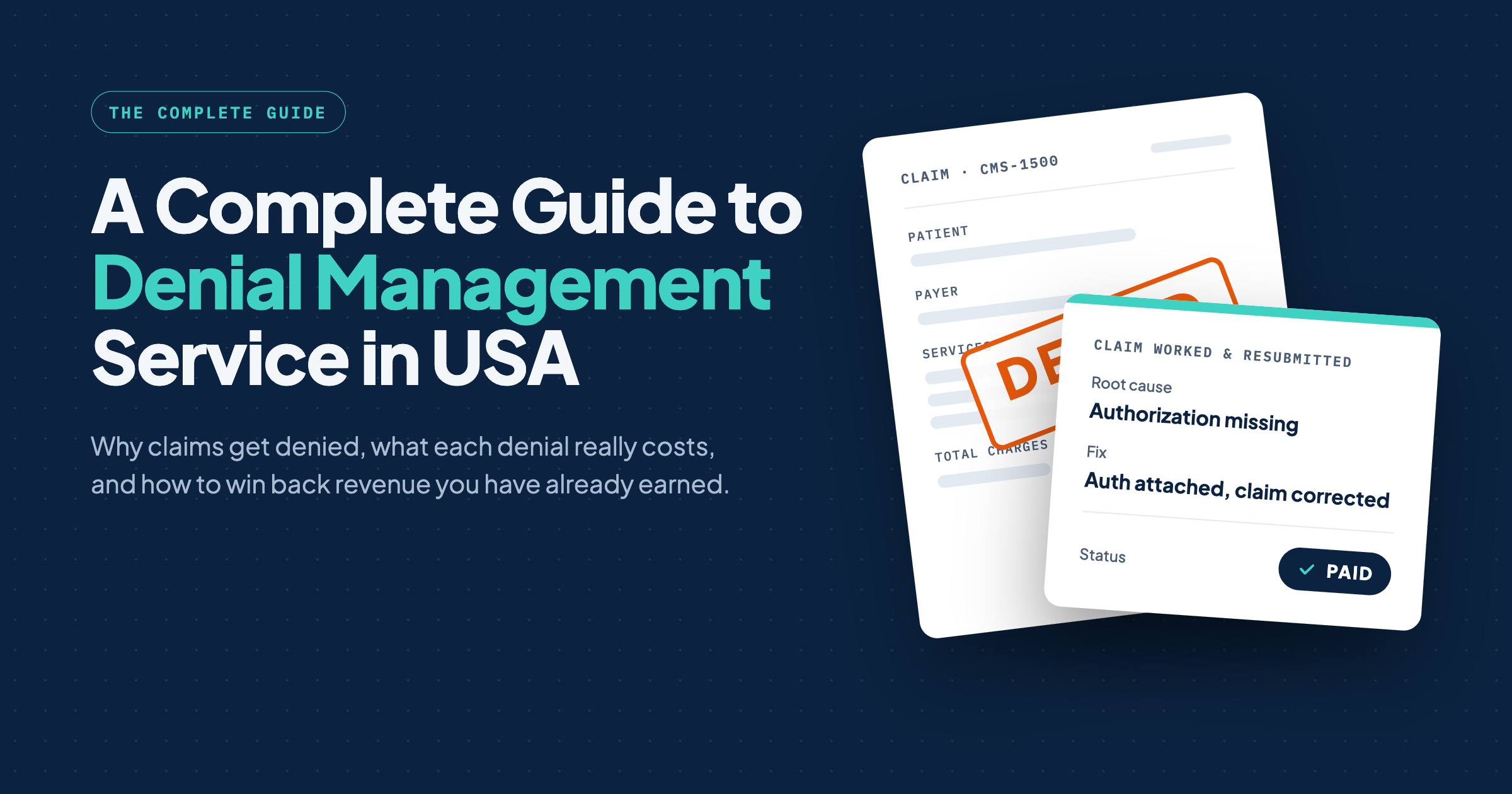
A denial management service in the USA handles the process of reviewing, appealing, and resolving insurance claim denials so your practice recovers revenue it has already earned. Without a structured denial management system, most practices lose between 10% and 15% of total revenue to claims that are never followed up on.
Key Takeaways
- 15% of submitted claims are denied on average, and 65% of those are never resolved, meaning that revenue disappears permanently
- A denial management service tracks, categorizes, and appeals denied claims before deadlines expire
- Practices that work with a dedicated billing and denial partner typically see revenue increases of 16% or more after onboarding
- The top denial reasons are nearly always preventable with proper claim scrubbing and eligibility verification
- Allied Health practices including physical therapy, chiropractic, and occupational therapy are especially vulnerable to high denial rates due to authorization-heavy payer rules
- Choosing the right partner means looking beyond generic outsourcing toward specialists who understand your specific specialty
Why Denied Claims Cost More Than Most Practice Owners Realize

When a claim gets denied, it does not just pause payment. It triggers a chain of administrative work: reviewing the denial reason, gathering documentation, writing the appeal, resubmitting within the payer’s deadline, and tracking the outcome. Every step in that chain takes time your team may not have.
Here is the financial reality for a practice generating $500,000 in annual revenue:
- 15% of claims denied means roughly $75,000 in disputed revenue per year
- 65% of those denied claims never get appealed, putting $48,750 permanently at risk
- Even recovering half of those unchallenged denials adds more than $24,000 back into your revenue cycle
Multiply that across a multi-provider practice and the numbers become serious quickly. For practices in physical therapy, chiropractic, occupational therapy, and speech therapy, payer rules around prior authorizations and visit limits make denials even more frequent than in general medical billing.
This is why a dedicated denial management service matters. It creates a repeatable system for catching denials early, categorizing them by reason code, prioritizing high-dollar appeals, and hitting every payer deadline consistently.
How an Outsource Denial Management Services Actually Works
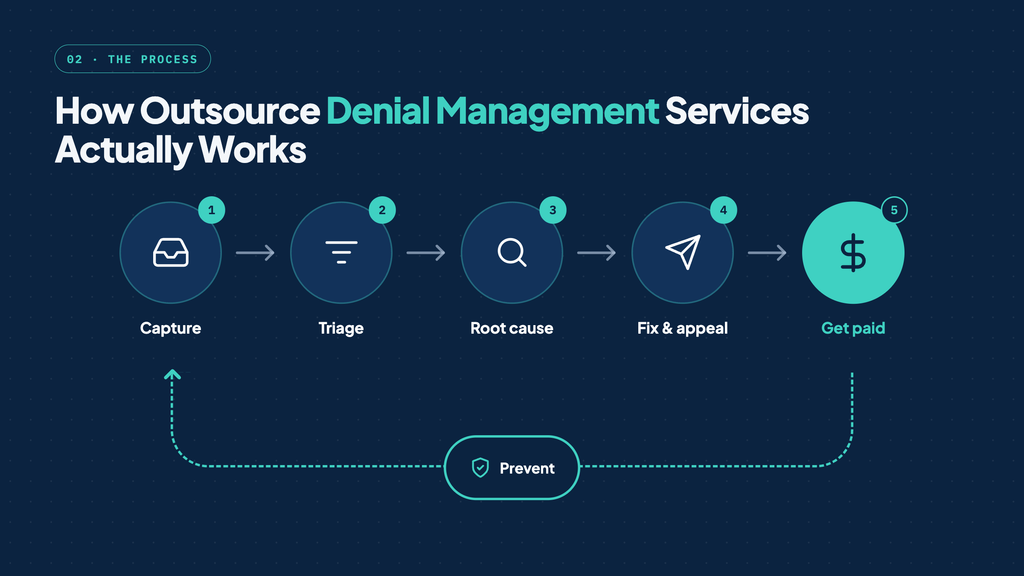
Understanding the workflow behind denial management helps you evaluate whether a partner is actually doing the job or just processing paperwork.
Step 1: Claim scrubbing before submission
The best denial prevention happens before a claim is ever submitted. A quality billing team scrubs each claim against current payer-specific rules, checking for missing modifiers, incorrect diagnosis codes, authorization mismatches, and eligibility gaps. Perform Practice Solutions maintains a 98% clean claim rate across client accounts by catching these issues at the front end.
Step 2: Denial identification and categorization
When a denial does come back, it is logged, categorized by denial reason code, and assigned a priority level based on dollar amount and appeal deadline. Common reason codes include:
- CO-4: Incorrect procedure code or modifier
- CO-11: Diagnosis inconsistent with procedure
- CO-16: Claim lacks information needed for adjudication
- CO-97: Bundling or duplicate claim issues
- PR-204: Service not covered by payer plan
Step 3: Root cause analysis
Good denial management does not just appeal and resubmit. It asks why the denial happened and whether it is part of a pattern. If a specific payer is denying physical therapy claims for a particular code, fixing the upstream process prevents the same denial from recurring across dozens of future claims.
Step 4: Appeal and resubmission
Appeals are written with the appropriate clinical documentation, payer-specific language, and supporting records. Timelines vary by payer, typically ranging from 30 to 180 days, so tracking deadlines is non-negotiable.
Step 5: Performance reporting
Monthly reporting shows denial rates by payer, denial reason, provider, and specialty. Quarterly reviews go deeper, benchmarking your rates against industry standards and identifying which payers are creating the most friction.
Comparing Denial Management Approaches: In-House vs. Outsourced
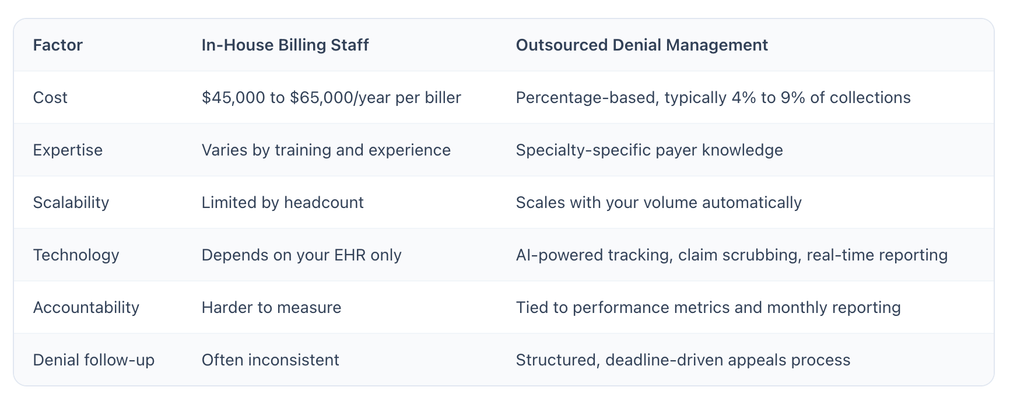
For most small-to-midsize Allied Health practices running two to ten providers, outsourcing denial management produces better financial outcomes than maintaining an in-house biller who also handles scheduling, authorizations, and front-desk duties. The specialization gap is simply too large.
The Top Denial Reasons and How to Prevent Them
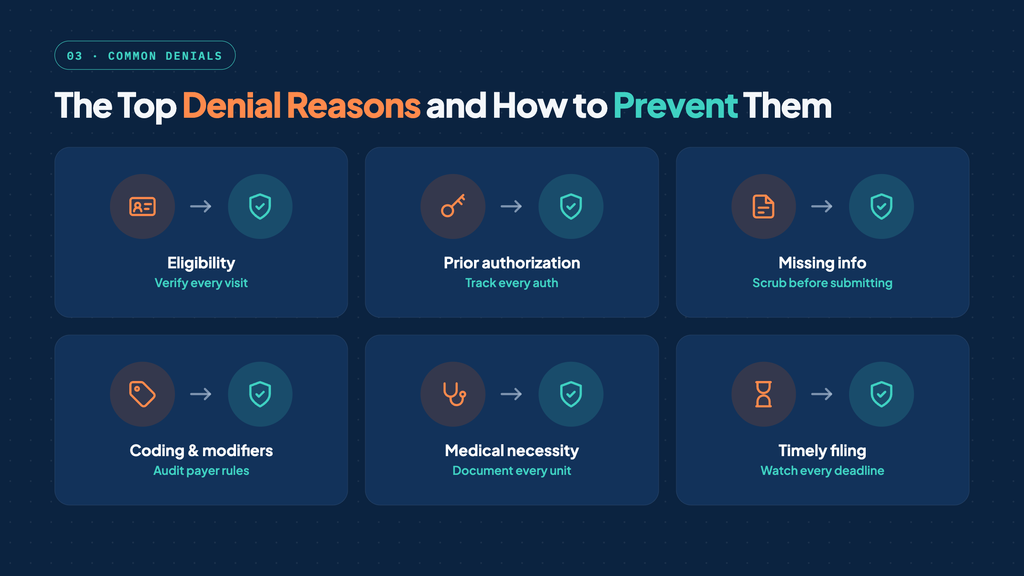
Understanding which denials hit your specialty most often is the first step toward prevention. In healthcare denial management services usa, the five most common denial categories are:
- Missing or expired prior authorizations: Physical therapy and occupational therapy claims frequently require payer authorization for each course of treatment. Letting authorizations lapse mid-treatment is one of the most avoidable and costly denial patterns.
- Eligibility and coverage errors: Billing for services on a date when the patient’s coverage had lapsed, or billing the wrong plan due to secondary insurance confusion, triggers immediate denials.
- Coding errors: Using outdated CPT codes, missing required modifiers, or mismatching diagnosis codes to procedures creates automatic rejections in most payer systems.
- Lack of medical necessity documentation: Insurers increasingly require detailed clinical documentation to justify continued care, especially for therapy visits beyond the initial evaluation period.
- Timely filing violations: Claims submitted after the payer’s filing deadline are denied and generally cannot be appealed. Most payers require submission within 90 to 365 days of service depending on the contract terms.
Each of these denial types is largely preventable with the right combination of claim scrubbing technology, trained billing staff, and real-time eligibility verification.
What to Look For in a Healthcare Denial Management Services Partner
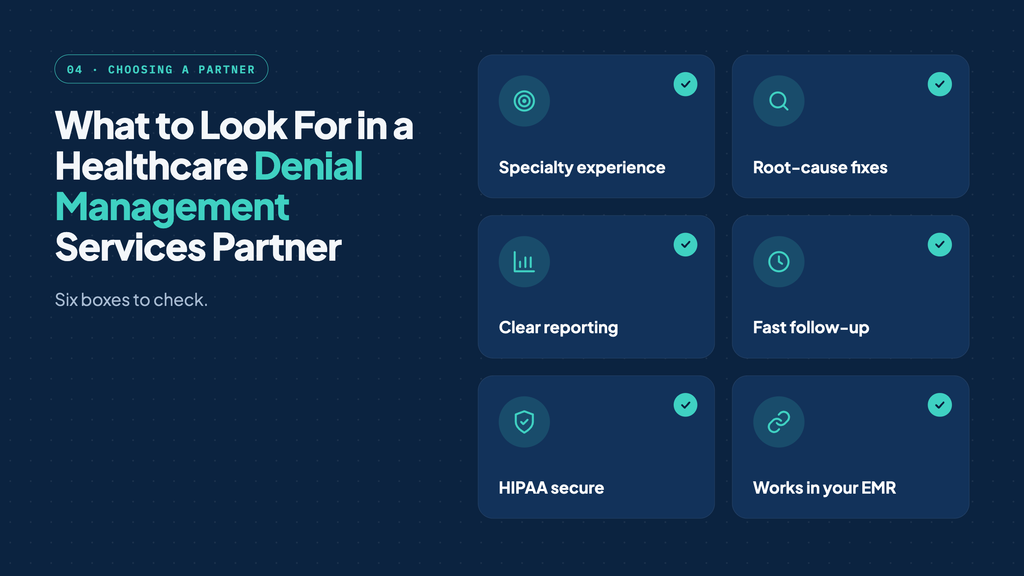
Not every billing company treats denial management the same way. Some process appeals reactively and only when the dollar amount justifies the effort. A strong denial management service in USA operates proactively, with systems built around preventing denials before they happen and recovering revenue systematically when they do.
Key qualities to evaluate:
- Specialty-specific expertise: Your denial partner should know the CPT codes, payer rules, and authorization requirements specific to your practice type, not just general medical billing.
- Transparent reporting: You should be able to see denial rates by payer, reason code, and provider at any time, not just when you ask for a report.
- Technology integration: AI-powered claim tracking, automated eligibility checks, and real-time denial alerts speed up response times and reduce human error.
- Dedicated point of contact: Practices that pass through a rotating customer service team lose context and accountability. A named billing contact who understands your accounts makes a measurable difference.
- Appeal success rates: Ask prospective partners for their average appeal success rate and how they track it. A serious billing company measures this.
Perform Practice Solutions builds denial management into its full revenue cycle process. Daily billing submission instead of weekly batches means claim problems are caught faster. The proprietary AI monitoring system flags stalled claims, lapsed authorizations, and unusual payer behavior before they turn into lost revenue.
Things to Know
- The 65% of denied claims that never get appealed represent permanent revenue loss, not just delayed payment.
- Payer contracts often include specific appeal language requirements. A generic appeal letter is less effective than a payer-tailored response.
- Credentialing gaps directly cause denials. If a provider’s enrollment lapses with a payer like BCBS, Aetna, or UnitedHealthcare, all claims from that provider may be denied retroactively.
- Most payers process initial claims within 14 to 30 days, but appeals can take 30 to 90 days depending on the payer and the complexity of the dispute.
- Small practices are disproportionately affected by denials because they have less administrative bandwidth to manage follow-up.
- Denial rates above 5% are generally considered a red flag in the billing industry. If your practice is above that, a systematic audit is overdue.
Conclusion
Denied claims are not a billing inconvenience. They represent revenue your providers have already delivered care to earn, and every unresolved appeal is money that will not come back. A structured denial management service in USA creates the systems, accountability, and specialty-specific expertise your practice needs to recover what it is owed and prevent future losses before they compound.
Whether your practice is running two providers or ten, whether you are in physical therapy, chiropractic, or occupational therapy, the financial case for professional denial management is clear.
Schedule a free strategy session with Perform Practice Solutions and find out exactly how much recoverable revenue is sitting in your unresolved claim queue right now.
Frequently Asked Questions
The top five denial types are missing or expired authorizations, eligibility and coverage errors, coding and modifier mistakes, lack of medical necessity documentation, and timely filing violations.
Medical billing companies typically acquire clients through referrals, specialty-focused digital marketing, healthcare conference networking, and strategic partnerships with practice management consultants.
HCA Healthcare is the largest for-profit hospital system in the United States, operating more than 180 hospitals across 21 states.
Other major systems include CommonSpirit Health, Ascension, and Tenet Healthcare. For Allied Health and outpatient practices, the landscape is far more fragmented, with most practices operating as independent or small group clinics that rely on third-party billing and practice management support.
Medical denial management services are specialized billing support functions that track, appeal, and resolve insurance claim denials to recover revenue that has already been earned by a practice.
These services include identifying denial patterns, filing payer-specific appeals, correcting claim errors, and implementing front-end processes to reduce future denials. The goal is to reduce the percentage of revenue lost to unresolved claim disputes.
Claim denial management services refer to the structured process of responding to insurance denials through categorization, root cause analysis, appeal writing, and resubmission within payer deadlines.
A comprehensive claim denial management process goes beyond reactive appeals. It includes monthly reporting on denial trends, payer-specific strategy adjustments, and upstream changes to coding and documentation practices to prevent the same issues from repeating.