
A medical accounts receivable service manages the process of tracking, following up on, and collecting payments owed to your healthcare practice after services are rendered. When this function is handled correctly, your cash flow tightens, claim denials drop, and your team spends less time chasing payments.
If you run a physical therapy, chiropractic, occupational therapy, or speech therapy clinic, you already know how quickly unpaid claims pile up. According to industry data, 15% of submitted claims are denied outright, and 65% of those denials are never resolved.
That means a significant portion of the revenue your practice has already earned simply disappears. The right billing partner and receivables process can recover 10 to 15% of your total practice revenue that would otherwise be lost to poor follow-up, missed deadlines, or unresolved appeals.
Why Accounts Receivable Management Is the Financial Backbone of Any Practice
Most clinicians focus on patient outcomes. That focus is necessary, but it often means the administrative side of the practice runs on autopathy. Billing gets batched. Claims sit for days before submission. Follow-up calls on denials happen inconsistently, or not at all.
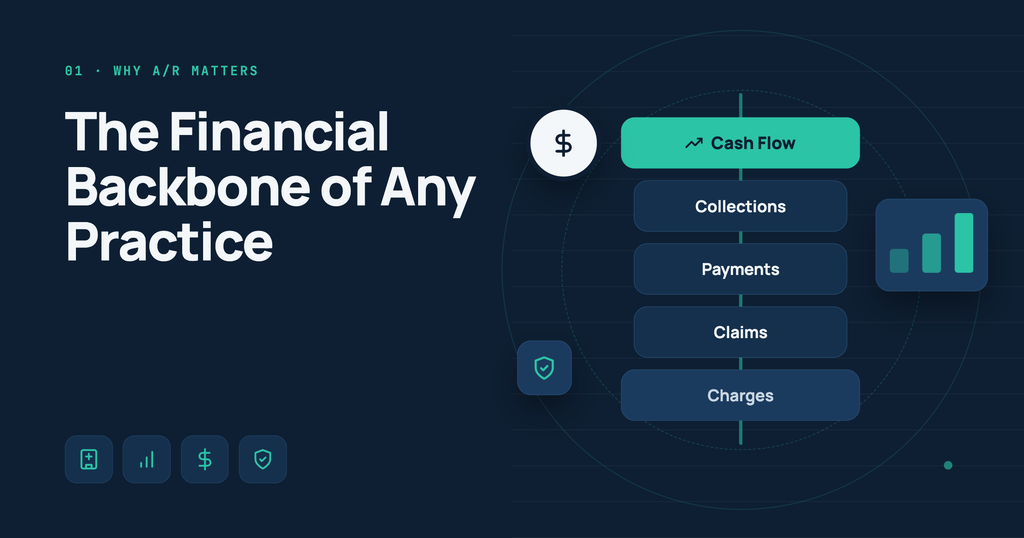
The industry average billing cycle runs 45 to 60 days. That means money your practice earned in January might not land in your account until March, if it lands at all. That lag creates cash flow gaps that force owners to make uncomfortable decisions: delay equipment purchases, limit hiring, or dip into reserves.
Effective receivables management compresses that timeline. Practices that bill daily rather than in weekly batches and scrub claims against payer rules before submission often see cash flow move in closer to three weeks. That difference is not a small one over the course of a year.
Ready to improve your cash flow and recover unpaid claims? Visit our Virtual Medical Assistant page to know more.
The Real Cost of Unmanaged Receivables
When receivables are not actively managed, three things happen in sequence. First, claims sit beyond payer filing deadlines and become uncollectable by default. Second, denials go unanswered because no one is tracking appeal windows. Third, patient balances go unbilled or uncollected because the process stops at the insurance side.
Each of those scenarios represents money your practice already earned. The clinical work was done. The only variable is whether someone followed through on the administrative side.
Practices running 2 to 10 or more providers are particularly vulnerable because the volume of claims scales faster than the front desk capacity to manage them.
What a Medical Accounts Receivable Service Actually Does Day to Day
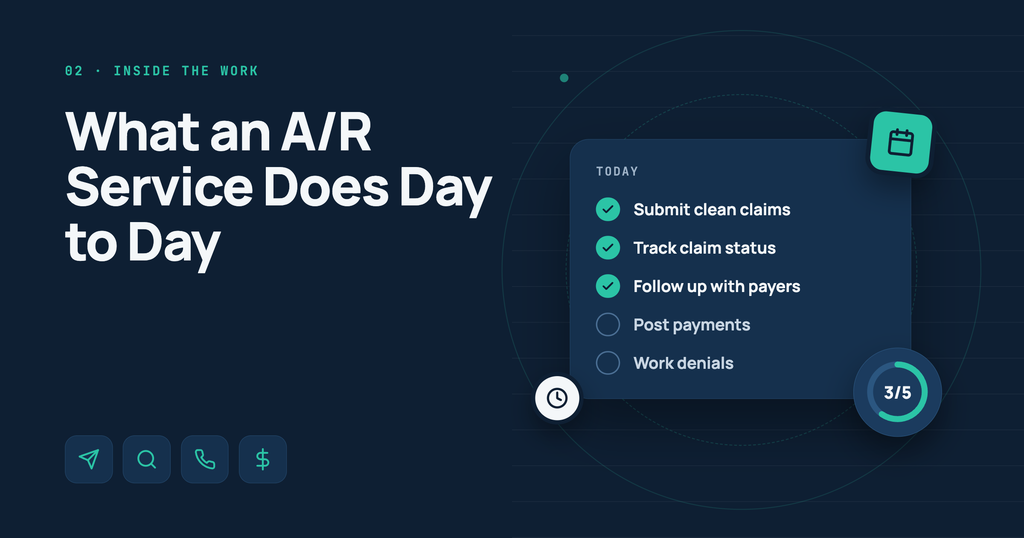
A dedicated receivables function is not just about sending invoices. It involves a structured set of daily and weekly tasks that keep every dollar in motion from the moment a claim is submitted to the moment it is collected.
Here is what that workflow typically looks like in practice:
- Claim submission: Claims are prepared, scrubbed against current payer rules, and submitted daily rather than batched.
- Denial management: Every denial is reviewed, categorized, and either appealed or corrected and resubmitted within payer timelines.
- Payment posting: Insurance and patient payments are posted accurately and matched to the correct accounts.
- Aging report review: Outstanding balances are sorted by payer and aging bucket (30, 60, 90, 120+ days) to prioritize follow-up.
- Patient billing: Statements and payment requests are sent for balances not covered by insurance.
- Monthly reporting: Practice owners receive transparent performance data showing collection rates, denial rates, and outstanding balances.
A medical accounts receivable service handles all of these functions on your behalf, either as a standalone service or as part of a broader practice management engagement.
What Separates a Good Service from an Average One
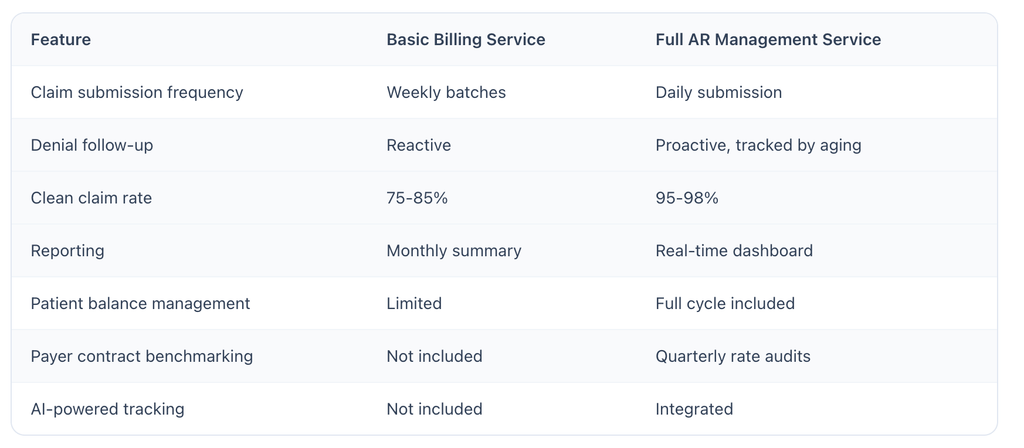
Not every billing vendor approaches receivables the same way. The difference between a 98% clean claim rate and a 75% clean claim rate comes down to process discipline, payer-specific knowledge, and the technology used to flag problems before they become denials.
The strongest providers use AI-powered tracking to surface stalled claims, flag credentialing gaps that would block payment, and identify patterns in denial codes that point to systemic billing errors. Without that layer of visibility, problems compound silently until they show up as a cash flow crisis.
Common Denial Patterns That Drain Your Receivables
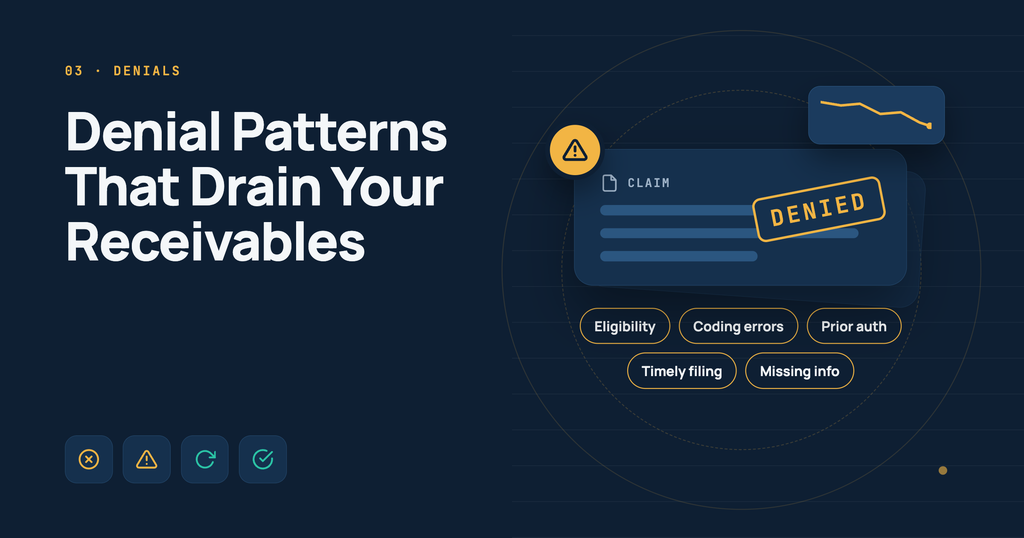
Understanding where denials come from is half the battle. If your team is not categorizing and tracking denial codes, you are likely repeating the same billing errors month after month.
The top five denial categories in medical billing tend to follow a predictable pattern:
- Missing or invalid patient information: Incorrect insurance ID numbers, date of birth mismatches, or missing authorization numbers trigger automatic rejections before a human ever reviews the claim.
- Non-covered services: The billed procedure is not covered under the patient’s current plan, often because eligibility was not verified before the visit.
- Duplicate claims: A claim is submitted more than once for the same date of service, either by error or as part of a resubmission workflow that was not properly tracked.
- Credentialing and enrollment issues: The rendering provider is not yet enrolled with the payer, or their credentials have lapsed. This type of denial can affect dozens of claims at once.
- Untimely filing: The claim was submitted after the payer’s filing deadline, making it uncollectable regardless of whether the service was valid and covered.
The fourth denial type is worth particular attention. A single credentialing lapse can block payment across an entire provider’s claim history with a given payer. Catching that kind of issue early requires active monitoring, not just periodic check-ins.
The Role of a Medical Accounts Receivable Specialist

Whether you hire in-house or work with an external service, someone needs to own the receivables function. In most practices, this role is handled either by a dedicated specialist or distributed across the front desk team, which typically leads to inconsistency.
A medical accounts receivable specialist is responsible for the full lifecycle of a claim after submission. Their day-to-day work includes reviewing explanation of benefits (EOB) documents, identifying underpayments, posting payments, working denial queues, and communicating with payers to resolve outstanding balances.
They also manage patient-facing billing communications, including statements, payment plan setups, and balance dispute resolution. In practices with multiple providers, a specialist may also support coordination between billing codes and clinical documentation to ensure that services are captured correctly at the point of care.
When this role is outsourced to a full-service provider, you gain access to a team rather than a single individual. That means built-in redundancy, broader payer knowledge, and access to technology infrastructure your in-house hire could not realistically maintain alone.
Things to Know
- The 45 to 60 day billing cycle is an industry norm, not a fixed reality. Practices that submit claims daily can cut that timeline to roughly three weeks.
- Clean claim rate is one of the most important metrics in medical billing. A rate below 90% signals a systemic problem in your billing process that will compound over time.
- Credentialing gaps do not just delay revenue, they can retroactively block payment for claims already submitted if the issue is discovered during a payer audit.
- Patient balance management is often the weakest link in a practice’s revenue cycle. Many billing vendors stop at the insurance side and leave patient collections entirely unaddressed.
- CAQH profiles must be updated regularly. An outdated CAQH profile can stall provider enrollment across multiple payers simultaneously.
- Not all medical billing software is created equal. The platform your billing partner uses determines how much real-time visibility you actually have into your revenue cycle.
Conclusion
If your practice is running a 45 to 60 day billing cycle, carrying a denial rate above 10%, or leaving patient balances unaddressed after insurance processes, you are almost certainly leaving recoverable revenue on the table. A properly managed medical accounts receivable service is not an administrative luxury. It is the operational infrastructure that determines whether the work your clinical team does every day actually results in a financially stable practice.
Perform Practice Solutions works with Allied Health practices across the country to tighten billing cycles, increase clean claim rates, and build the kind of receivables infrastructure that supports sustainable growth. With a 98% average clean claim rate, 48-hour claim submission turnaround, and monthly reporting that gives you full visibility into your revenue cycle, the path to faster collections is clear.
Book a strategy session with the Perform Practice Solutions team today and take the first step toward a practice that gets paid for every dollar it earns.
Frequently Asked Questions
Accounts receivable in medical refers to the total amount of money owed to a healthcare practice for services already provided but not yet paid by insurers or patients.
The top five denial types are missing or invalid patient information, non-covered services, duplicate claim submissions, credentialing or enrollment issues, and untimely filing.
There is no single dominant platform, but widely used options include Kareo, AdvancedMD, athenahealth, Epic, and Jane App, with selection typically depending on specialty and practice size.
Physical therapy and chiropractic practices often use Jane App or WebPT, while larger multi-specialty groups tend to use Epic or athenahealth. The best platform for your practice depends on your EMR, payer mix, and the level of reporting detail you need.
A medical accounts receivable specialist manages the full post-submission billing cycle, including payment posting, denial resolution, patient balance follow-up, and EOB review.
They serve as the operational engine of your revenue cycle. Their work ensures that every submitted claim either results in payment or is actively appealed, and that patient balances are billed, tracked, and collected in a timely manner.
A medical accounts receivable service is responsible for daily claim submission, denial management, payment posting, aging report review, patient billing, and performance reporting.
Depending on the scope of the engagement, these responsibilities may also include eligibility verification, prior authorization tracking, payer contract benchmarking, and coordination with credentialing to prevent enrollment-related payment blocks.